Home › Methods › TCSPC

Methods

Time-Correlated Single Photon Counting

Timing individual photons to measure fluorescence lifetime.

TCSPC detects single photons emitted by a sample and measures when each one arrives relative to the laser pulse that excited it.

Repeated over millions of pulses, these arrival times build up the fluorescence decay. Its precision and photon efficiency make TCSPC a reference technique for time-resolved spectroscopy and FLIM.

Minimal TCSPC setup and the resulting photon arrival-time histogram

Each photon is timed against the laser pulse that excited it. Collected over millions of pulses, these arrival times build up a histogram: the fluorescence decay. Schematic.

01 Principle

What is TCSPC?

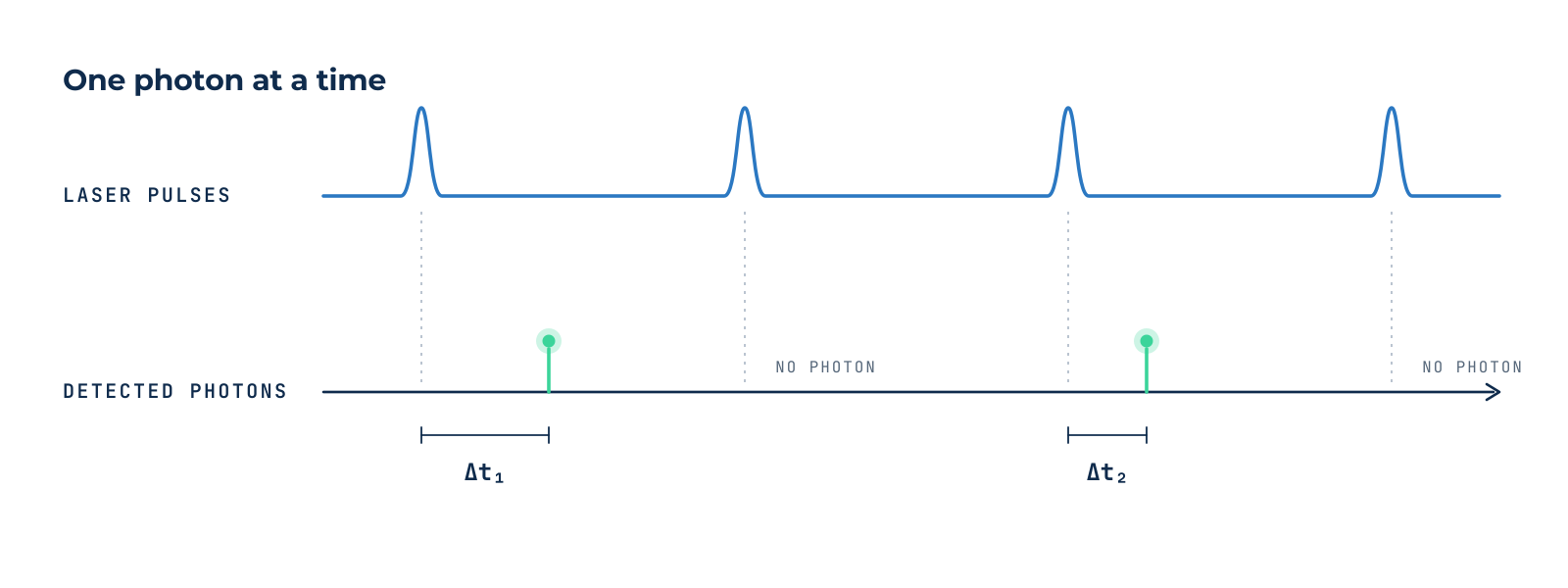
A pulsed laser excites the sample at a fixed repetition rate. A single-photon detector registers emitted photons, and timing electronics measure the delay between each photon and the laser pulse that preceded it.

The light is kept weak enough that at most one photon is detected per laser period; most periods record no photon at all. This is what allows each photon to be timed precisely.

Laser pulses and detected photons with delay Δt

Figure 1 · For each detected photon, the delay Δt from the laser pulse is measured. Most pulses produce no photon.

02 Decay curve

Building the decay curve

The measured delays are sorted into time bins, typically picoseconds wide. As photons accumulate, the histogram takes the shape of the fluorescence decay, from which the lifetime is extracted.

Model-based

Fitting methods

Least-squares fitting, maximum-likelihood estimation, global fitting.

Model-free

Non-fitting methods

Phasor analysis, rapid lifetime determination (RLD), center-of-mass, integral extraction and other geometrical approaches.

Precision grows with the number of photons

A single-exponential lifetime can be estimated from a few hundred photons, while separating several components needs more.

The histogram of photon arrival times is the fluorescence decay

Figure 2 · The histogram of arrival times reproduces the fluorescence decay.

03 Setup

The minimal setup

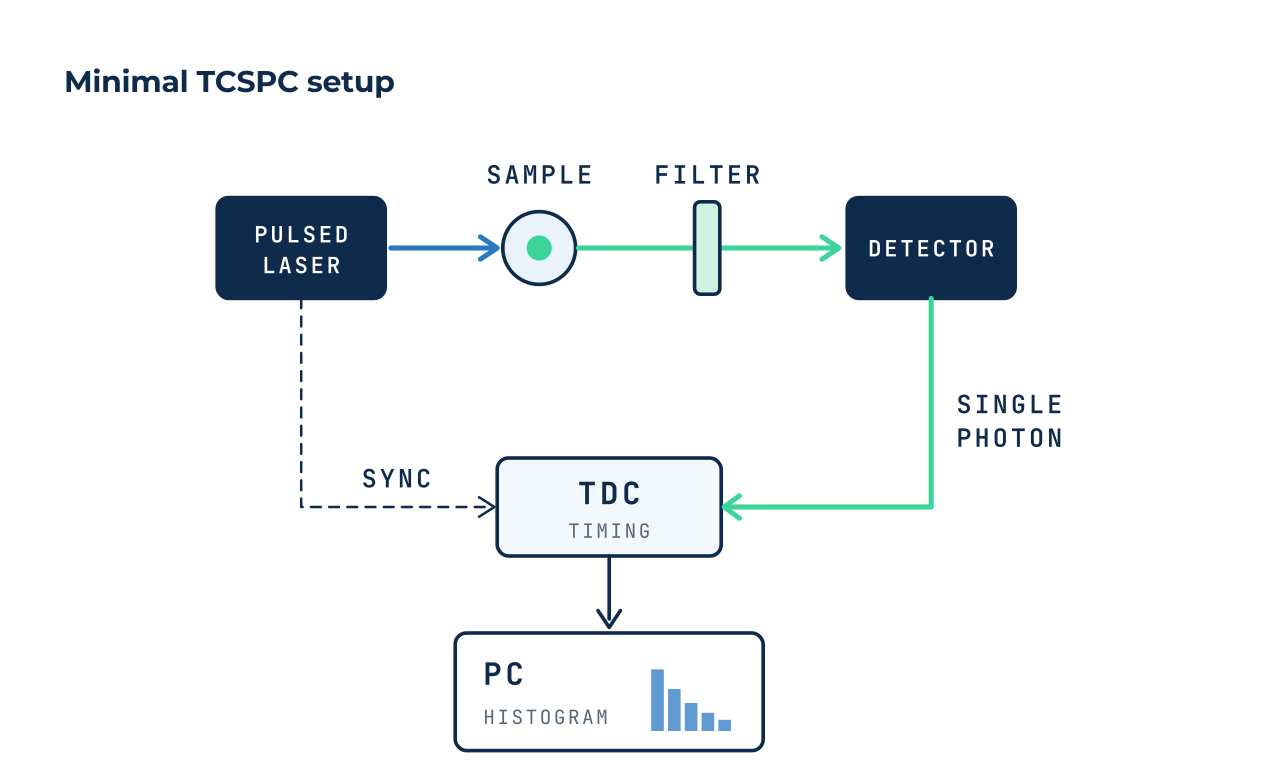
Three elements are enough to build a TCSPC system: a pulsed excitation source, a detector sensitive to single photons and electronics that time every photon.

01

Pulsed laser

Short pulses at a repetition rate chosen so the decay has time to complete between pulses.

02

Single-photon detector

Such as a SPAD, a hybrid detector or a fast PMT.

03

Timing electronics

Time-to-digital conversion of each photon against the laser sync signal, and histogramming.

Minimal TCSPC setup

Figure 3 · Each laser pulse sends a sync signal to the time-to-digital converter (TDC), which times every detected photon against it; the PC builds the histogram. An emission filter blocks scattered laser light.

04 Good practice

Measuring reliably

A few precautions make TCSPC measurements accurate and comparable.

01

Instrument response function (IRF)

The timing response of the whole system, recorded with a very short-lived sample or a mirror and used when fitting the decay.

02

Reference standard

A dye with a known lifetime checks the system and calibrates the phasor plot, for example with the FLIM-Phasors Calibration Kit.

03

Count rate

Too many photons per pulse distort timing (pile-up) and artificially shorten the lifetime, so the count rate is kept well below the laser rate.

05 Applications

From TCSPC to FLIM

Without scanning, TCSPC records the decay of a whole sample, for example a solution in a cuvette. Combined with a scanning microscope, each pixel gets its own histogram, producing a fluorescence lifetime image (FLIM).

Read about phasor analysis

Further reading

References

1Lakowicz JR. Principles of Fluorescence Spectroscopy. 3rd ed. Springer; 2006. doi:10.1007/978-0-387-46312-4

2Becker W. Advanced Time-Correlated Single Photon Counting Techniques. Springer; 2005. doi:10.1007/3-540-28882-1

3Becker W. Fluorescence lifetime imaging – techniques and applications. Journal of Microscopy. 2012;247(2):119–136. doi:10.1111/j.1365-2818.2012.03618.x

4Valeur B, Berberan-Santos MN. Molecular Fluorescence: Principles and Applications. 2nd ed. Wiley-VCH; 2012. doi:10.1002/9783527650002

5Li Y, Liu L, Xiao D, et al. Lifetime determination algorithms for time-domain fluorescence lifetime imaging: a review. In: Fluorescence Imaging – Recent Advances and Applications. IntechOpen; 2022. doi:10.5772/intechopen.106423

6Eljebbawi A, Dolata A, Strotmann VI, Weidtkamp-Peters S, Stahl Y. From principles to practice: a comprehensive guide to FRET-FLIM in plants. Methods in Microscopy. 2025;2(1):33–43. doi:10.1515/mim-2024-0019

From principle to measurement

TCSPC with FLIM LABS

Compact TCSPC acquisition for spectroscopy and lifetime imaging.