
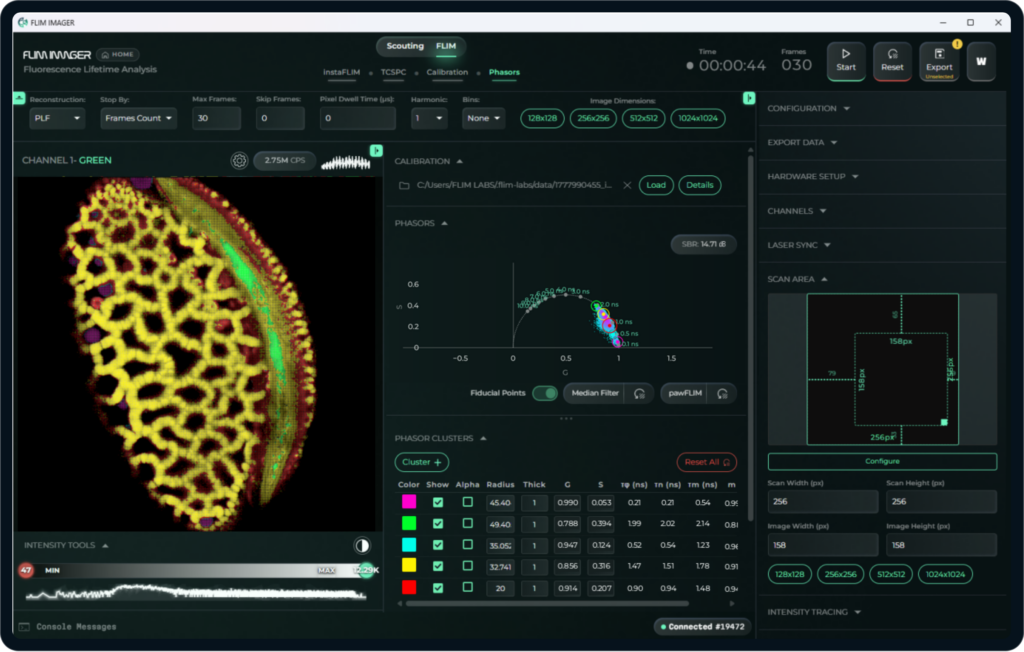
Real-time acquisition, image reconstruction, and phasor analysis in one software platform.
Every photon carries information, but making sense of millions of photon arrivals is another challenge entirely. How do you turn those fleeting signals into an image that reveals what is happening inside a sample?
FLIM IMAGER is designed to do just that, bringing acquisition, reconstruction, and analysis together in a single interface. Working with the FLIM LABS Data Acquisition Card, it supports up to eight channels, real-time acquisition, and post-processing. A guided configuration wizard simplifies hardware connection, laser synchronisation, and imaging setup.
Four reconstruction modes — Pixel-Line-Frame (PLF), Pixel-Frame (PF), Line-Frame (LF), and Frame-only (F) — accommodate different scanning configurations, including a dedicated setup for Abberior STEDYCON systems.
The software offers customizable colormaps, contrast adjustments, magnification, and region-of-interest (ROI) analysis. Scouting mode allows users to inspect individual frames and adjust acquisition parameters, while FLIM mode provides four analysis tools:
- InstaFLIM maps average fluorescence lifetime onto image pixels.
- TCSPC displays fluorescence decay histograms and signal-to-background ratios.
- Calibration uses reference samples to correct timing measurements.
- Phasors represents fluorescence decays as points on a phasor plot, allowing lifetime populations to be explored without curve fitting.
Phasor analysis includes filtering, clustering, continuous 2D colormaps, and two- or three-component unmixing to map different lifetime populations across a sample.
Data can be exported with experimental metadata and automatically generated Python and MATLAB scripts for further analysis.
From photon detection to lifetime mapping, FLIM IMAGER brings acquisition, reconstruction, and analysis into a single workflow.