
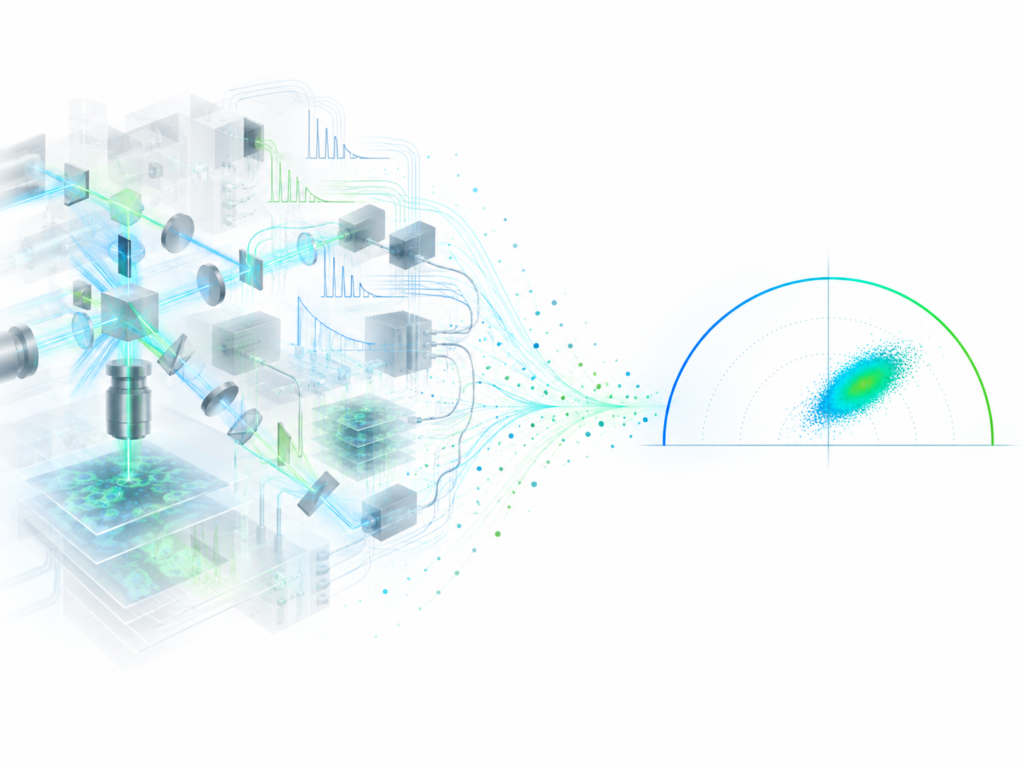
How fluorescence lifetime imaging can move from a specialized technique to a more accessible everyday tool for research
For a long time, fluorescence lifetime imaging has lived in a strange position. Scientifically, its value has been clear. FLIM can reveal information that intensity-based imaging often misses, because it does not only measure how much light a sample emits, but how long that fluorescence lasts. This lifetime dimension can tell researchers about molecular environment, metabolism, interactions, autofluorescence, and changes inside biological or material samples. And yet, despite this potential, FLIM has often remained a specialist technique.
One reason is historical. The market for FLIM was relatively small, and many companies developing advanced microscopy systems could not build instruments dedicated only to fluorescence lifetime imaging. Instead, FLIM was usually offered as one capability inside larger, more complex platforms designed to perform several techniques. These systems could be extremely powerful, but they were not built around FLIM alone.
This shaped access. If a researcher wanted to perform FLIM, they often had to buy into an instrument that could do much more than FLIM. That meant higher costs, larger systems, more complex workflows, and, in many cases, a level of investment that made sense only for major facilities or specialized labs that needed multiple advanced imaging modalities at once.
For researchers who simply wanted to use FLIM, this created a barrier. The technique was available, but not always approachable. The measurement was valuable, but the path to performing it could be too expensive or too complicated.
Today, however, the situation is changing. Interest in fluorescence lifetime imaging is growing across biology, medicine, materials science, photonics, and industrial research. More researchers are beginning to understand that lifetime is not just an extra feature, but a different way of reading fluorescence. At the same time, optical components, detectors, timing electronics, and data-analysis workflows have evolved. This makes it possible to rethink what a FLIM instrument can be.
Instead of treating FLIM as one expensive option inside a broader multipurpose platform, FLIM LABS’ goal is to build instruments designed specifically for fluorescence lifetime imaging. FLIM-exclusive systems can focus on what researchers actually need to acquire, reconstruct, and analyse lifetime data, without forcing them to pay for unnecessary complexity.

This does not mean making FLIM less rigorous. It means making the route to FLIM more direct. Democratizing FLIM means lowering the practical barriers that have historically limited its adoption: cost, complexity, integration, portability, and usability. It means creating instruments that can enter existing laboratories more easily, connect with real workflows, and help more users explore lifetime imaging without needing to rebuild their entire setup around a large, closed system.
In this sense, accessibility is not a marketing slogan. It is an engineering direction. A more accessible FLIM system has to be compact, reliable, understandable, and precise. It has to preserve the scientific value of lifetime imaging while making the technology easier to adopt.
That is the shift: from FLIM as a specialized capability reserved for a few, to FLIM as a measurement that more researchers can consider part of their everyday toolbox.
The future of fluorescence lifetime imaging will not depend only on making the most complex instruments possible. It will also depend on making the right instruments possible: focused, practical, and accessible enough to bring lifetime information to more questions and more laboratories.