
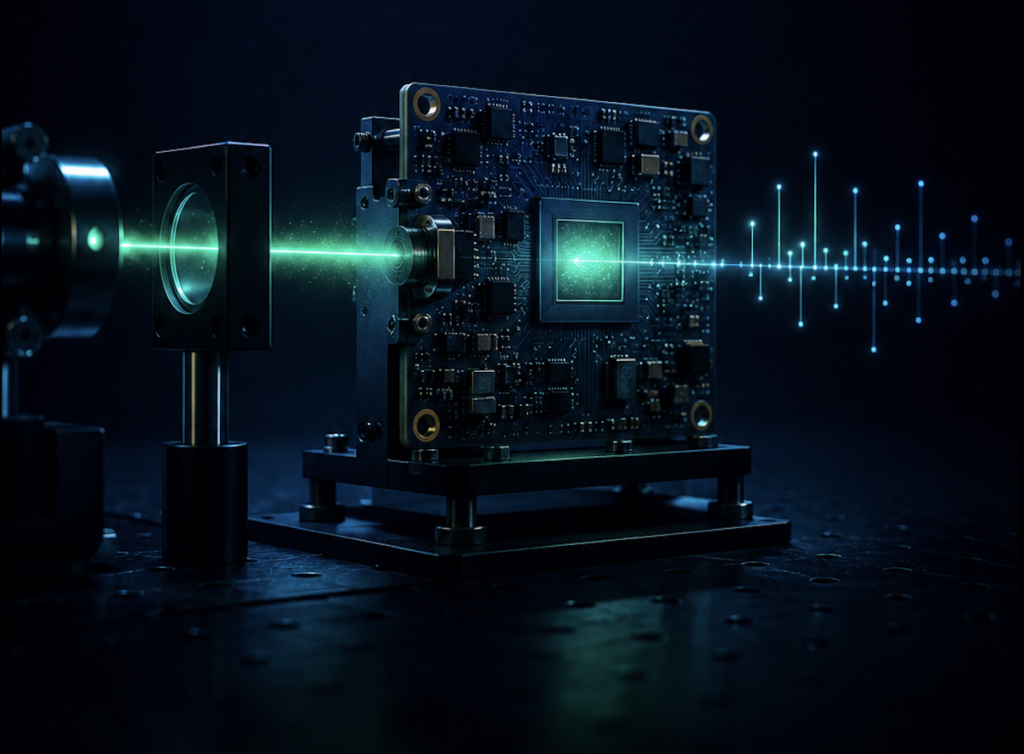
In the age of AI, deep-tech breakthroughs still depend on the physical machinery that makes ideas measurable.
We have become used to thinking of innovation as something that happens invisibly. It appears inside a server, inside a model, inside a layer of computation that most people will never touch. A result arrives on a screen and seems detached from any physical origin, as if knowledge could now be generated without friction or alignment.
That impression is powerful, and sometimes misleading. In deep tech, the world still has to be persuaded to produce a signal. A biological sample still has to emit light, a detector still has to catch it, an electronic system still has to preserve its timing, and a researcher still has to trust that what appears on the screen corresponds to something real. Between an idea and a measurement there is always a physical chain, and every link in that chain can shape the result.
Artificial intelligence has changed the way researchers process information. It can accelerate interpretation, support design, uncover correlations and shorten the path between raw data and insight. Its impact is already visible across science and technology. Yet in experimental disciplines, the quality of intelligence downstream depends on the quality of measurement upstream. Before data can be analysed, it has to exist. Before a pattern can be found, the instrument has to capture the phenomenon with enough precision for the pattern to mean something.
This is where hardware remains central to deep-tech innovation. The most advanced algorithm cannot decide whether a photon was detected cleanly if the acquisition layer was unstable. It cannot reconstruct a reliable lifetime distribution from timing information that was never properly recorded. It cannot make an optical system easy to integrate if the underlying electronics were designed without laboratory workflows in mind. The real power of software begins when the physical measurement is solid enough to carry meaning.
Fluorescence lifetime imaging is a good example of this relationship. FLIM measures how long fluorescence lasts after excitation, usually on the scale of nanoseconds. The scientific value can be extraordinary, because lifetime carries information that brightness alone may hide. It can reflect the molecular environment, interactions, autofluorescence signatures, metabolic changes and local conditions inside a sample. The final image may look elegant and intuitive, but its creation depends on a precise dialogue between light, detection and timing electronics.
That dialogue is unforgiving. A lifetime image is built from photon arrival times, and those arrival times depend on the way the entire system is designed. The excitation source, detector, synchronization signal and acquisition card all participate in the measurement. If the system is well designed, the researcher sees a usable map of lifetime populations. If it is poorly matched to the experiment, the data may become difficult to interpret long before any analysis begins.
For this reason, instrumentation is never just a container for software. It is part of the scientific method. The hardware defines what can be measured, how easily it can be measured, and how confidently the result can be used. A device that works beautifully in one controlled environment may fail to become useful if it cannot fit into the practical reality of a laboratory. Cables, space, power, compatibility and installation time sound like secondary concerns until they become the reason an experiment does not happen.
Much of deep-tech engineering lives in those details. The public story of innovation often celebrates breakthroughs, while the laboratory story is more patient. Someone has to decide how a module is powered, how signals are converted, how timing references are handled, how data move to the computer, how the user interacts with the acquisition, and how the system behaves when connected to instruments built by different manufacturers. These choices rarely appear dramatic, yet they decide whether a technology becomes usable beyond the group that invented it.
This is especially important for technologies that aim to become more accessible. FLIM has strong scientific potential, but adoption depends on the ability to bring lifetime imaging into existing optical environments. Many laboratories already have microscopes, detectors, laser sources or imaging workflows that researchers know and trust. The question is how to add the lifetime dimension without asking every user to rebuild their setup around a completely new instrument.
A good deep-tech product respects that context. It does not assume that the laboratory exists for the device. It understands that the device enters a world already full of constraints, habits and equipment. The goal is to make the new measurement possible while reducing unnecessary disruption. When hardware is designed with that philosophy, accessibility becomes something concrete. It means fewer barriers between the scientific question and the experiment.
The same reasoning applies to collaboration. Hardware innovation rarely travels alone. It moves through demonstrations, technical conversations, distributors, application specialists and partners who understand the needs of local users. A technology becomes credible when people can see how it behaves in their own environment. Trust grows through use, through support, through the feeling that an advanced measurement is no longer reserved for a small group of specialists.
In the AI era, this physical and relational side of innovation may become even more important. As computational tools grow more capable, researchers will ask more from their instruments. They will expect richer data, faster feedback and workflows that connect measurement and analysis more naturally. The instruments that succeed will be those built with enough precision to feed advanced analysis and enough practicality to survive everyday use.
There is a quiet discipline in making hardware for science. It requires attention to signals that last less than a blink, to components that must cooperate without drama, to interfaces that should disappear into the workflow. It also requires a certain humility, because an instrument ultimately serves a question larger than itself. The best systems do not ask researchers to admire the engineering. They let researchers move closer to the phenomenon they came to study.
AI may change how discoveries are made, but it does not remove the need to measure the world carefully. Deep tech still depends on the moment when an idea becomes a device, when a device enters a laboratory, and when a signal becomes trustworthy enough to support a conclusion. The algorithm may help interpret the experiment. The experiment still needs something built well enough to listen.