
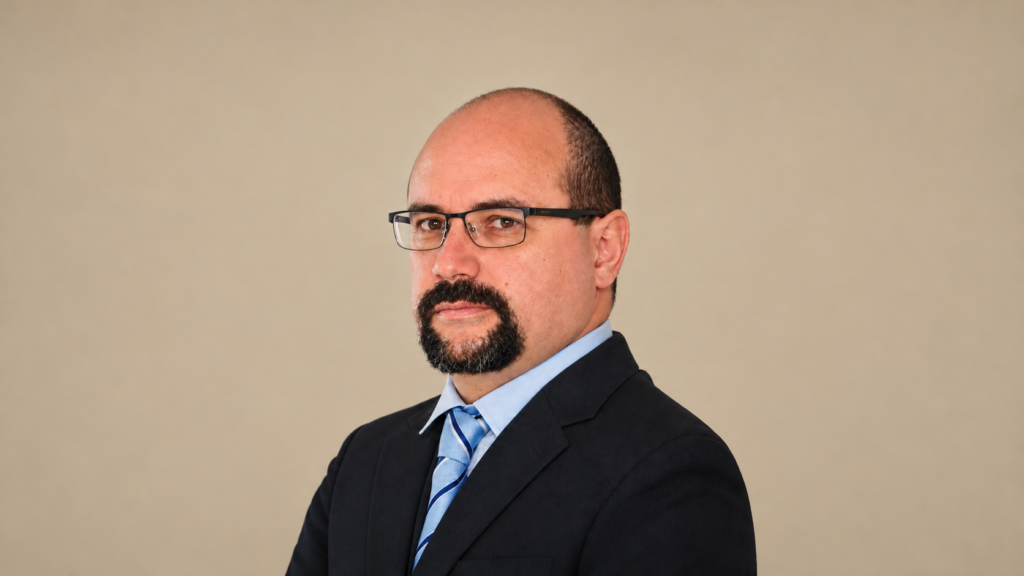
From distinguishing autofluorescence to combining different imaging techniques, Alvaro Crevenna, Head of the Light Imaging Facility at EMBL Rome, discusses how FLIM is evolving and why making it more accessible could open the door to new applications.
To begin, could you briefly introduce yourself and your work at EMBL?
I’m Alvaro Crevenna, and I’ve been Head of the Light Imaging Facility at EMBL Rome since 2019. My background is in molecular and cellular biology, as well as biophysics.
FLIM has traditionally been considered a rather specialized technique. From your experience, how has its adoption changed over the years? Is it becoming more common in routine research?
I first encountered fluorescence lifetime measurements through single-molecule FRET experiments. In those experiments, lifetime measurements were an essential part of the process, helping us calibrate the measurements and convert FRET efficiencies into distances between donor and acceptor molecules. At the time, FLIM was not widely used in biology. It was mostly associated with specialized applications and niche systems. I think the situation has gradually changed, partly thanks to commercial technologies from companies such as Leica, which have helped introduce FLIM to a broader range of users.
What can fluorescence lifetime measurements reveal that conventional intensity-based microscopy cannot? Are there particular applications where FLIM could make a difference?
Fluorescence lifetime gives us an additional parameter beyond intensity, allowing us to build a more complete picture of a sample. One particularly interesting application, which I think is sometimes underestimated, is distinguishing autofluorescence in biological tissues. Autofluorescence can be difficult to remove or separate from other fluorescent signals using conventional imaging. However, when we characterize fluorescence according to its lifetime, we can distinguish different contributions to the signal. This helps us identify which regions correspond to autofluorescence and which contain the fluorescence we’re actually interested in measuring. It provides another way of understanding what we’re looking at.
Despite its potential, FLIM is still not equally accessible to all laboratories. What are the main barriers, and could overcoming them encourage wider adoption?
That’s certainly true. FLIM is often included as part of more complex instrumentation, either as a commercial add-on or within high-end microscopy systems. This makes it relatively expensive and therefore difficult for many laboratories to access. There’s also the technical aspect. Researchers need to know how to use the technology and interpret the measurements. The combination of cost and technical expertise has helped keep FLIM within a relatively specialized community. But I certainly believe this can change. Once a technology becomes more accessible, more people start using it. And as researchers become familiar with it, they begin thinking of different ways to apply it. That naturally creates opportunities for new applications.
Looking ahead, what do you think will be the next major frontier in microscopy? And what role could FLIM play in that future?
That’s a good question! If I had to make a prediction, I would put my money on multimodal imaging. The idea is to investigate the same sample in several different ways, combining multiple types of measurements to obtain a more complete picture of what’s happening. Achieving this will require advances in instrumentation, but also better integration between different technologies and the data they produce. Ultimately, the goal is to bring together different perspectives on the same sample. I believe FLIM should be one of those perspectives because it provides a very particular type of information that other measurements cannot offer. And coming back to accessibility, I think that’s where things become especially interesting. Once the technology becomes easier to access, researchers will have more freedom to experiment with it. In a sense, FLIM could become something they can really play with, explore, and use in ways we haven’t necessarily thought of yet. That’s when I expect the number of applications to really grow.