
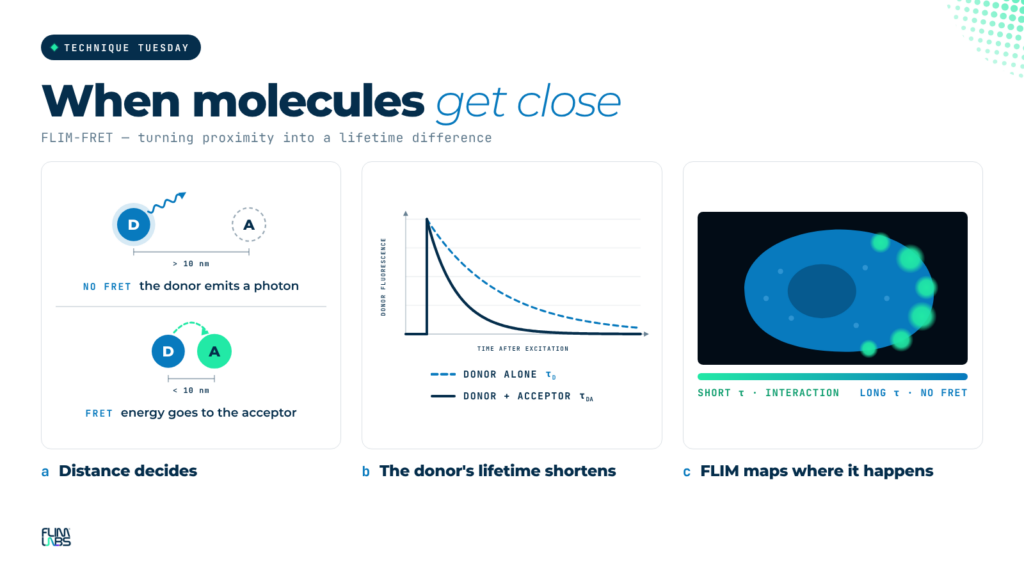
How fluorescence lifetime reveals interactions between molecules just nanometres apart.
How can researchers detect interactions between molecules that are too close together to distinguish with conventional microscopy? One answer is Förster Resonance Energy Transfer, or FRET.
FRET occurs when an excited fluorescent molecule (the donor) transfers energy to a nearby molecule (the acceptor) without emitting a photon. Because this transfer happens only over about 1-10 nanometres, it acts as a molecular ruler: if FRET occurs, the two molecules must be very close.
But how can researchers measure whether this energy transfer is actually happening? One approach is to measure the donor’s fluorescence lifetime. When FRET occurs, the donor loses its excitation energy more quickly, causing its fluorescence lifetime to shorten.
Combining FRET with Fluorescence Lifetime Imaging Microscopy (FLIM) allows researchers to map these lifetime changes across a sample. Known as FLIM-FRET, this approach can reveal where molecular interactions occur without relying solely on fluorescence intensity.
By turning molecular proximity into measurable lifetime differences, FLIM-FRET has become a widely used tool for studying protein interactions, conformational changes, and cellular signalling.